
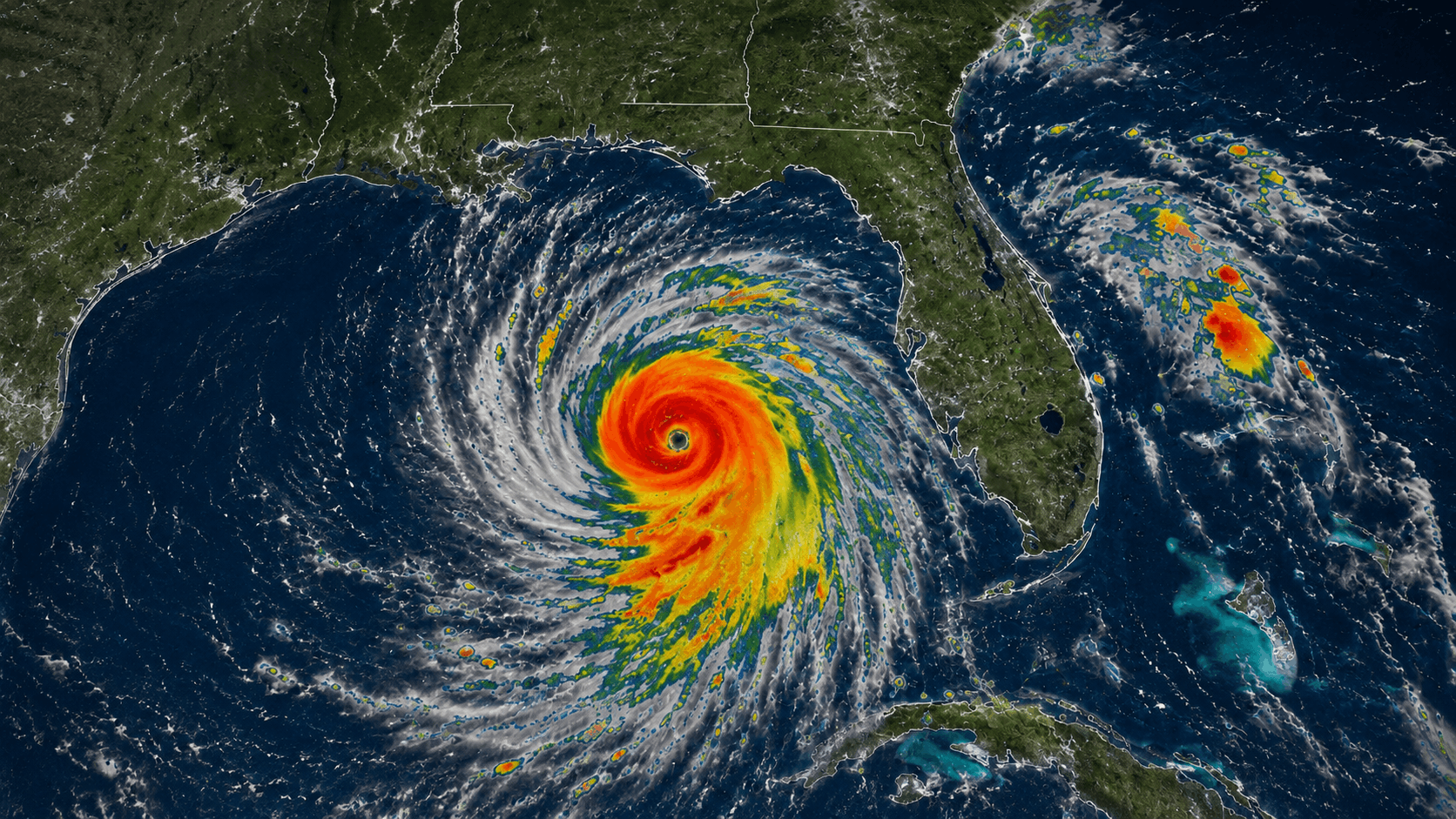
If you are choosing an outdoor structure in Florida, Miami-Dade NOA Approval is one of those details that really matters.
So, what does it mean? In simple terms, Miami-Dade NOA Approval is a product-specific acceptance from Miami-Dade County Product Control. It confirms that a product has been reviewed under the rules that apply to construction materials, including the Florida Building Code and, when noted, the High Velocity Hurricane Zone.
For Azenco Outdoor, NOA #25-0205.04 applies to the company’s motorized aluminum pergola, officially described in the document as the “R-BLADE Aluminum Louvered Pergola.” That approval is tied to a specific set of drawings, tested configurations, and installation requirements.
That last part is important: this is not a general “one-size-fits-all” wind claim. The approval is about the actual certified product assembly and how it is designed, tested, labeled, and installed.
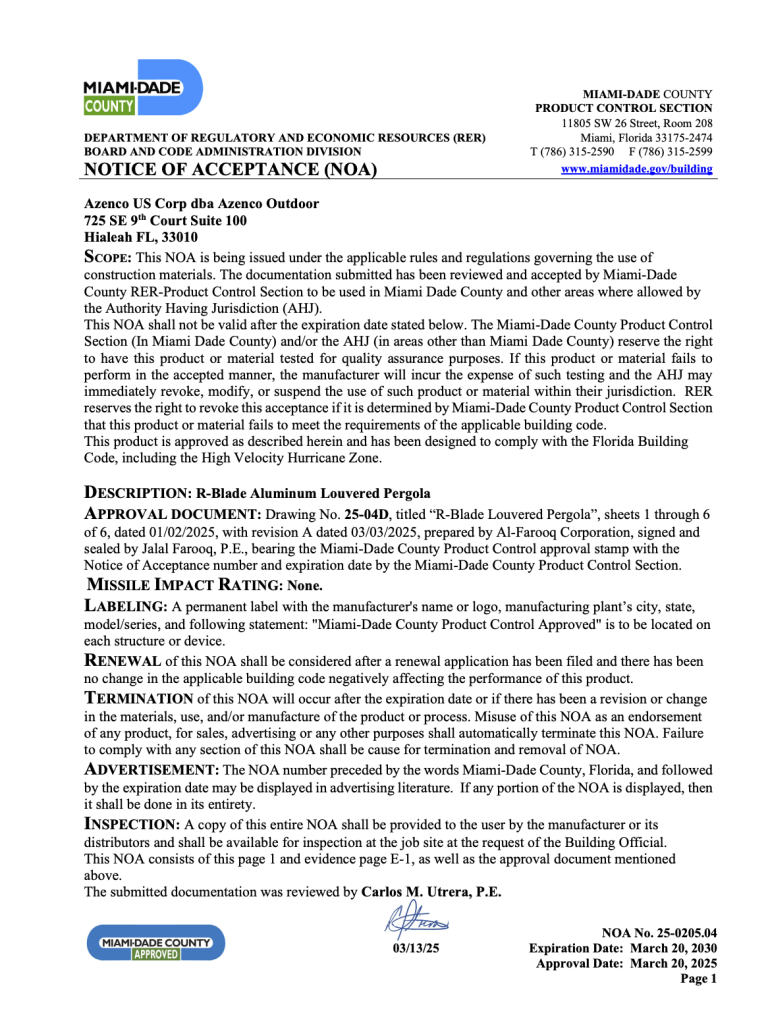
Miami-Dade NOA Approval stands for Notice of Acceptance. It is issued by the Miami-Dade County Product Control Section after documentation has been reviewed and accepted.
For outdoor living products, this type of approval helps answer a very practical question:
Has this product been reviewed for use under demanding building code conditions?
An NOA usually includes:
Azenco Outdoor’s R-BLADE™ Motorized Louvered Pergola is covered by Miami-Dade County, Florida Notice of Acceptance No. 25-0205.04, Expiration March 20, 2030. The approval document references Drawing No. 25-04D, titled “R-Blade Louvered Pergola,” sheets 1 through 6 of 6.
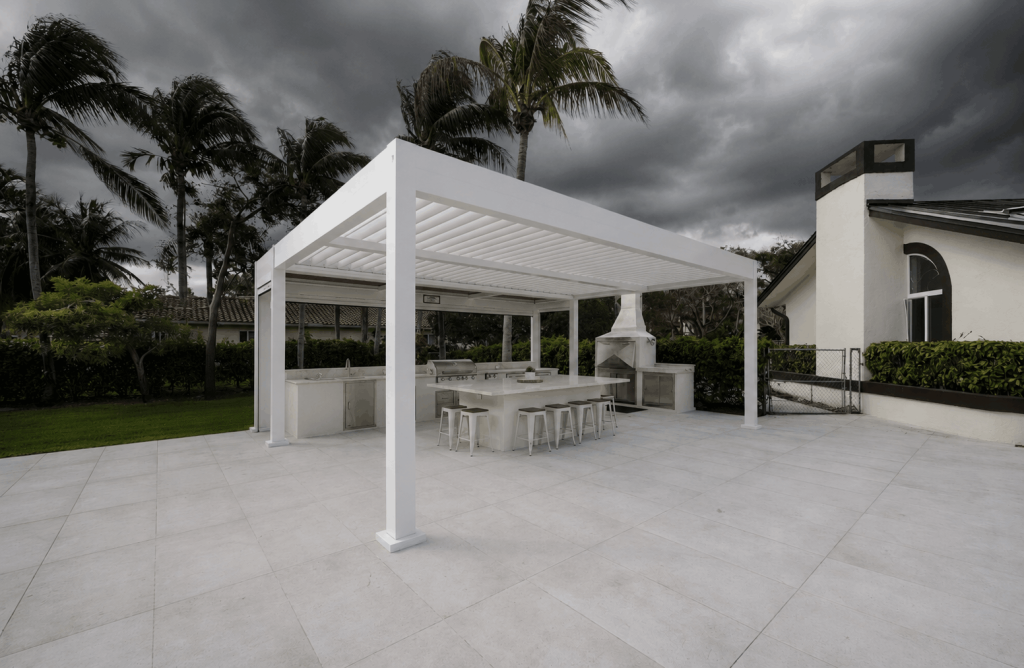
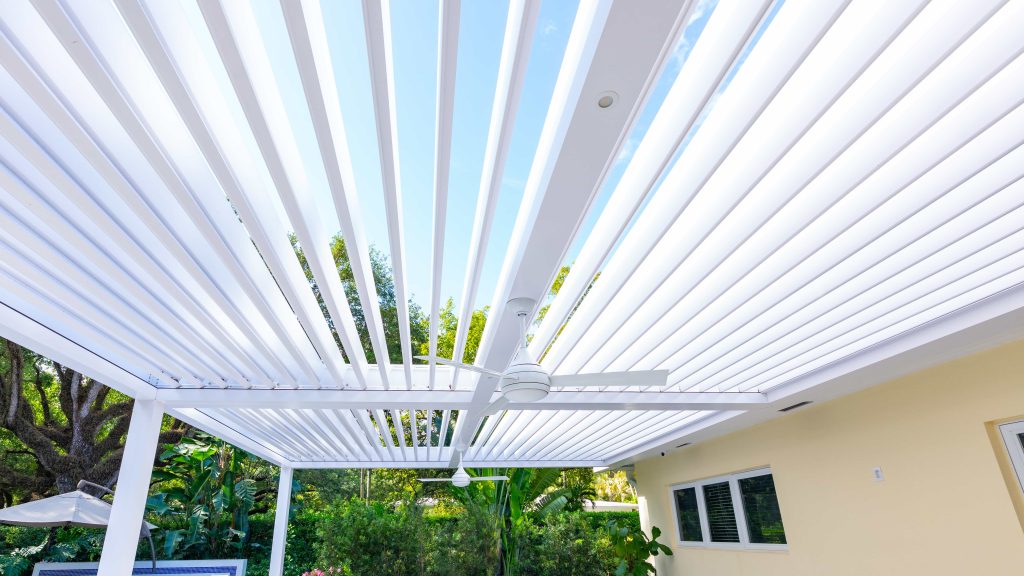
A smart louvered roof is not just a decorative shade structure. It includes moving louvers, framing, posts, motors, and engineered components that all need to work together.
That is why Miami-Dade NOA Approval matters. It gives architects, contractors, dealers, homeowners, and building officials a clear technical reference.
From working on outdoor living projects in Florida and other demanding climates, Azenco Outdoor has seen how often product documentation becomes part of the conversation early in the planning process. Homeowners may care about comfort and design first, but contractors and building departments need to understand how a product is documented.
An NOA helps support that process by providing:
For a motorized louvered pergola, that kind of documentation is especially helpful because the structure is both architectural and functional.
NOA #25-0205.04 applies specifically to Azenco Outdoor’s adjustable louvered pergola listed in the document as an aluminum louvered pergola system.
The NOA states that the product is designed to comply with the Florida Building Code, including the High Velocity Hurricane Zone, also known as HVHZ.
Here are the key details:
The approval is not meant to be separated from these details. It applies to the product as shown in the approved drawings and supported by the submitted test reports and calculations.
Florida Building Code compliance is a major part of building in Florida, especially in areas exposed to severe weather conditions.
HVHZ has stricter building code requirements because structures must be reviewed with high-wind conditions in mind.
For Azenco Outdoor’s motorized louvered pergola, the NOA states that the product has been designed to comply with:
This does not mean every project is automatically approved without review. Site conditions, mounting details, substrate, foundation, and local permitting requirements still matter.
A good way to think about it is this:
The NOA supports the product approval path, but the final installation still needs to follow the approved documents and local building requirements.
Our brochure is packed with inspiration, design options, and key details to help you make the right choice.
The evidence submitted for the R-BLADE NOA includes a Uniform Static Air Pressure Test, with loading per FBC TAS 202-94, together with marked-up drawings of pergola components. The submission also includes flexural-capacity calculations for the pergola blades.
These records support the product configuration described in the NOA and Drawing No. 25-04D. They should not be interpreted as separate certification of the motor software, control logic, smart-home functions, or every custom installation.
The approved drawings and project-specific requirements remain controlling. it has:
The product was evaluated through approved drawings and testing documentation.
That is the point of Miami-Dade NOA Approval: it is a documented acceptance of a specific product configuration, not a broad marketing shortcut.
The approved drawings include several structural and component details that help define the tested configuration.
The structural notes also reference the system’s overall weight. The total weight is approximately 1,700 lbs, with the louvers accounting for approximately 1,300 lbs.
That weight matters because a luxury pergola with motorized louvers is a real engineered system. It is not just a lightweight cover added on top of a patio.
Azenco Outdoor’s approach is to treat the outdoor louvered pergola as part of the architecture of the home or commercial space. That means the structure, movement, water management, and installation details all need to be considered together.
Azenco Outdoor’s smart pergola includes synchronized dual-motor operation with self-learning weight evaluation.
In simple terms, that means the system is designed to coordinate the movement of the louvers and evaluate the weight load during operation. This helps the adjustable roof pergola function smoothly as part of the overall engineered design.
This is important because motorization should never feel like an add-on. In a custom pergola, the moving components need to work with the structure, not against it.
For homeowners, the benefit is easy to understand: the outdoor roof can open, close, and adjust based on how the space is being used.
For builders and specifiers, the bigger value is that the motorized outdoor roof is backed by technical documentation and an approval package that clearly identifies the product and configuration.
This part is just as important as what the approval does mean.
Miami-Dade NOA Approval does not mean:
The NOA is tied to the approved drawings, tested configuration, and installation requirements. If a project changes the structure, mounting method, or conditions, it may require additional review by a qualified professional or the Authority Having Jurisdiction.
This is where experience matters. A common challenge clients face is assuming product approval and project approval are the same thing. They are related, but they are not identical.
The product approval gives the project team a strong technical starting point. The actual installation still needs to be reviewed based on the site.
If you are researching this modern pergola design for a Florida project, the best step is to review the official documentation directly.
You can view the certification here: View Miami-Dade NOA #25-0205.04
You can also learn more about the product here: Explore Azenco Outdoor’s motorized aluminum pergola
When reviewing the NOA, pay attention to:
These details help homeowners, contractors, and design professionals understand what the approval actually covers.
Miami-Dade NOA Approval gives Azenco Outdoor’s motorized aluminum pergola a clear technical reference for Florida Building Code and HVHZ compliance.
The most important thing to remember is that NOA #25-0205.04 is not about making a broad performance claim. It is about a documented, reviewed, and accepted product configuration.
For anyone planning a motorized louvered pergola project, that documentation can make a real difference. It helps support better planning, clearer permitting conversations, and more confidence in the product selection process.
Miami-Dade is known for having one of the most demanding product approval processes in the country, so having this level of documentation can help show that the product has gone through a serious technical review. While every project still depends on local code requirements and the Authority Having Jurisdiction, Miami-Dade NOA Approval gives architects, contractors, and homeowners a strong reference point when evaluating product quality and compliance.
Azenco Outdoor’s certified R-BLADE™ aluminum pergola brings together modern pergola design, motorized function, and technical documentation in one outdoor living solution.
No. NOA approval should not be described as “hurricane-proof.” It means the product has been reviewed under specific approved drawings, testing, and installation requirements.
light exterior, can create a more modern statement.Yes. NOA #25-0205.04 states that the product is designed to comply with the Florida Building Code, including the High Velocity Hurricane Zone.
Not automatically. The approval is tied to the documented configuration. Custom project conditions may still need review by the Authority Having Jurisdiction or a qualified professional.
You can review the official Miami-Dade NOA #25-0205.04 document here: LINK